


Development of the business EMSP and CPO platform integrated with open standards
True Energy is a Danish eMobility company developing smart charging solutions that connect electric vehicles, charging infrastructure and the energy market.
Their roadmap called for expertise in two directions at once. On the commercial side, they needed an eMSP platform built for business customers, with the elaborate price lists and user grouping that fleet and corporate accounts require. On the technical side, that platform had to integrate with their existing CPO system over OCPI, while their core product needed deeper connections to vehicles and charging hardware – work that demanded people fluent in open standards rather than generalists.

In a nutshell
Two systems developed in sequence: an eMSP platform for business customers with elaborate price lists and user grouping, and its integration with the client’s existing CPO system over OCPI 2.1.1. Alongside that, we contributed components to the core True Energy platform, from car manufacturer API communication to charging station management over OCPP 1.6.
Challenges
True Energy needed expert support to develop their flagship eMobility solutions. The first piece was an eMSP platform aimed at business customers, including the price list structure and the ability to group users – the kind of functionality that separates a consumer app from a product a company can actually run its fleet on. The second was seamless integration with their existing CPO system over OCPI 2.1.1.
As the collaboration matured we also took part in building out the core platform. That included communication with car manufacturers’ APIs, covering battery status interpretation and starting or stopping a charge from the vehicle side, and management of charging stations, from adding new units to connecting them over OCPP. Beyond the agreed scope, we regularly helped resolve open standards problems whenever the client’s team ran into them.
Our approach
The engagement started with one lead developer, joined by a second shortly after, deliberately beginning small enough to build a real understanding of what was needed before scaling the effort. Our eMobility specialists concentrated on the integration of open standards – OCPI 2.1.1 and OCPP 1.6 in this project – and on establishing the platform itself.
It mattered to us to be useful outside the boundaries of platform development too. Acting as a standards resource for the client’s own team, rather than only delivering our tickets, meant problems were solved where they appeared instead of waiting for the next planning round.
Where the vehicle meets the platform
Communication with car manufacturer APIs is what allows the platform to reason about the vehicle rather than just the charge point. Reading battery status and controlling sessions from the vehicle side opens the door to smarter charging logic for business customers – the difference between a system that records what happened and one that can act on what is happening.
Outcomes
EWE Go, one of Germany’s leading e-mobility operators, partnered with Solidstudio to upgrade their infrastructure with a flexible, high-performing Charge Point Management System tailored for rapid public network expansion and future fleet management. Solidstudio delivered the core CPMS platform along with custom feature extensions, charge point migration and now holds ongoing support via SLA

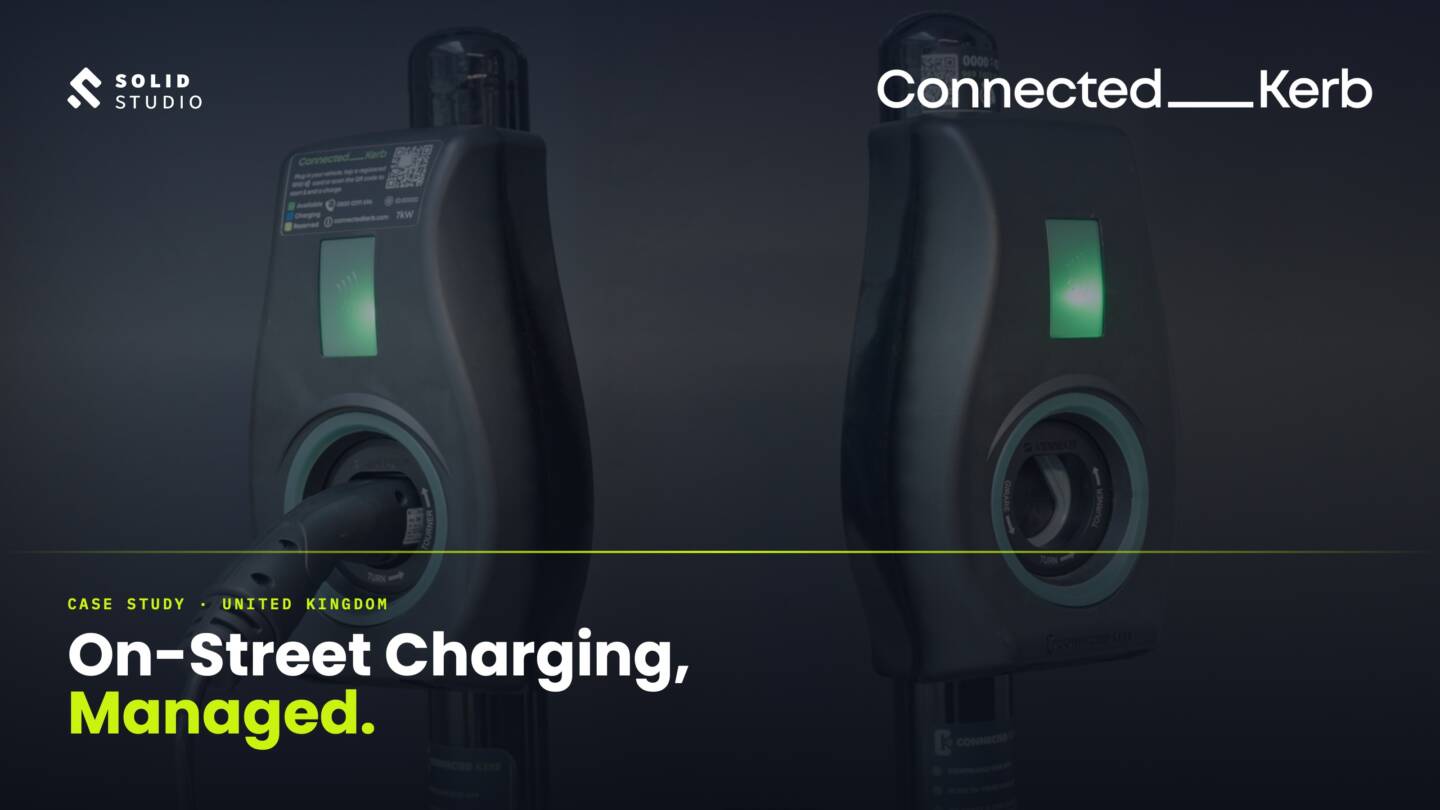
An advanced migration to our CPMS system backed by custom development and ongoing maintenance. Migration involved 9000 charging points. A particularly complex aspect was ensuring the integration of the current EMP system, including mobile app users and the OCPI partners already connected.

Comprehensive custom CPMS system and effective migration, seamlessly integrating with GreenWay’s existing digital ecosystem to future-proof their high-volume EV charging network across the CEE region.