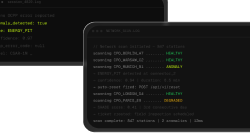
Build and expand your EV charging business. No need to rebuild it every time something changes.
Everything you need to run and connect charging networks is here – an app or the full stack.
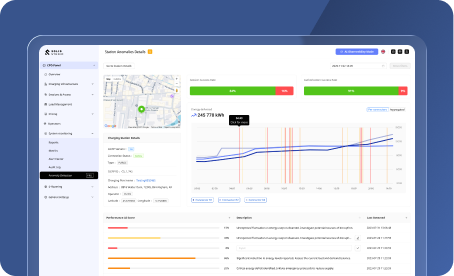

Scale your EV charging network on a centralized platform. Keep business stability with predictable revenue. As a CPO, you have full control over your stack. Cut hardware downtime costs and drive rapid, profitable expansion.
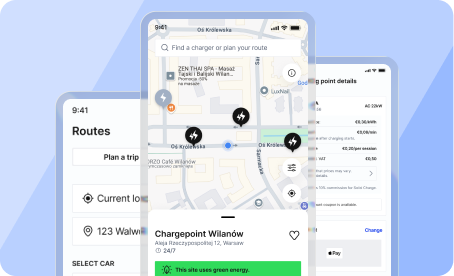

Launch your branded EV charging app without building it yourself. It ships as a driver app, a web back-office, or an API for your stack. Charging and payments come ready, with roaming included. The API goes live in 4 weeks. ISO 27001 certified.


Stop paying for charging faults you can’t even see. The tool catches the lost revenue and stuck sessions your monitoring misses. You can fix most of them automatically. No need to go to stations that weren’t broken. 97% detection accuracy.
Easy integration for every new charging model. The gateway links your management systems to any OCPP-compliant station (1.6 or 2.0.1). Scale across vendors. Your core software stays intact.
Ensure secure information exchange within the OCPI ecosystem (hubs or p2p partners) with our Anti Corruption Layer allowing smooth connection with OCPI 2.2 or 2.1.1.
Reach Hubject’s roaming network faster with the OICP Gateway. It handles the protocol complexity and security (SSL). Interoperability with the Hubject platform comes build in.
Add hardware from any OCPP-compliant vendor without locking in to one supplier. OCPP Proxy manages the protocol, so you don’t rebuild that layer for a new vendor.
Give external stakeholders a live view of network performance – without exposing core infrastructure. Get real-time metrics from CPMS, in isolated dashboard built for investors and partners.
Let any driver pay at the charger with a card or phone. No account, nothing to install. You keep the casual traffic that registration walls turn away.

For EV charging businesses, roaming integration and billing shape network reach. Native OCPI support connects CPOs and eMSPs, covering roaming, tariffs, locations, sessions, statuses, and charge detail records. AFIR requires ad hoc payment and price transparency, with obligations applying from 13 April 2024 and some payment requirements phasing in later.

Hardware-agnostic infrastructure keeps charger selection open and avoids vendor lock-in. OCPP standardizes communication between charging stations and the central system, with certified implementations available for 1.6 and 2.0.1. Centralized device management supports remote diagnostics and firmware updates, whether the backend runs on-premise or in the cloud.


Launch CPO/eMSP platforms in weeks using pre-built modules.

across 4 continents

Secure your charging revenue with guaranteed system reliability.

charging sessions processed monthly
Solidstudio covers the full EV charging stack: the CPO Platform (CPMS), a white-label eMSP driver app, and Network Intelligence. It is modular – you can also take single components: OCPP Gateway, OCPI Gateway, OICP Gateway, OCPP Proxy, Virtual Charge Point, or AFIR-compliant Digital Direct Payments. Start with one and add the rest when you need it.
OCPP 1.6 and 2.0.1, OCPI 2.2.1 and 2.3, OICP 2.3 (Hubject), and ISO 15118 / Plug & Charge. Our data model maps 1:1 to OCPI (Charging Pool – Charging Station/EVSE – Connector), so there is no translation layer when you share data with eMSPs or roaming networks.
Yes. OCPP Proxy, OCPI Gateway and Virtual Charge Point are CPMS-agnostic – they run alongside your current system to cut migration risk and improve maintenance across thousands of chargers. You do not have to replace everything at once.
Yes – two products, one interface. The CPO Panel and EMP Panel connect over pure OCPI, with no custom API layer between them. Run either on its own, or both behind a single login.
Yes. Peer-to-peer OCPI connections, Hubject (OICP 2.3) and Gireve. Self-roaming works out of the box when you run both our CPO Platform and eMSP app, and every handshake is monitored so you can see immediately if a roaming authorization fails and why.
Yes. AFIR-compliant Digital Direct Payments let drivers tap a card at the charge point – no app or registration needed. The eMSP app additionally supports cards, Apple Pay and Google Pay, fleet accounts and corporate monthly invoicing.
Yes – that is what load management is for. Set a total power budget for a group of stations and the platform distributes it dynamically across active sessions, redistributing unused headroom. Static caps and dynamic balancing keep you within grid and building limits, which matters most in dense urban sites and fleet depots.
A full audit log records every action for compliance reviews, CPO allow and block lists stop known bad tokens (including device-fingerprint blocking), and AI anomaly detection flags cloned or shared cards automatically – spotting physically impossible “teleporting token” sessions and usage far outside a token’s normal pattern.