

The most fragmented charging market in Europe: what Germany’s operator long tail actually means
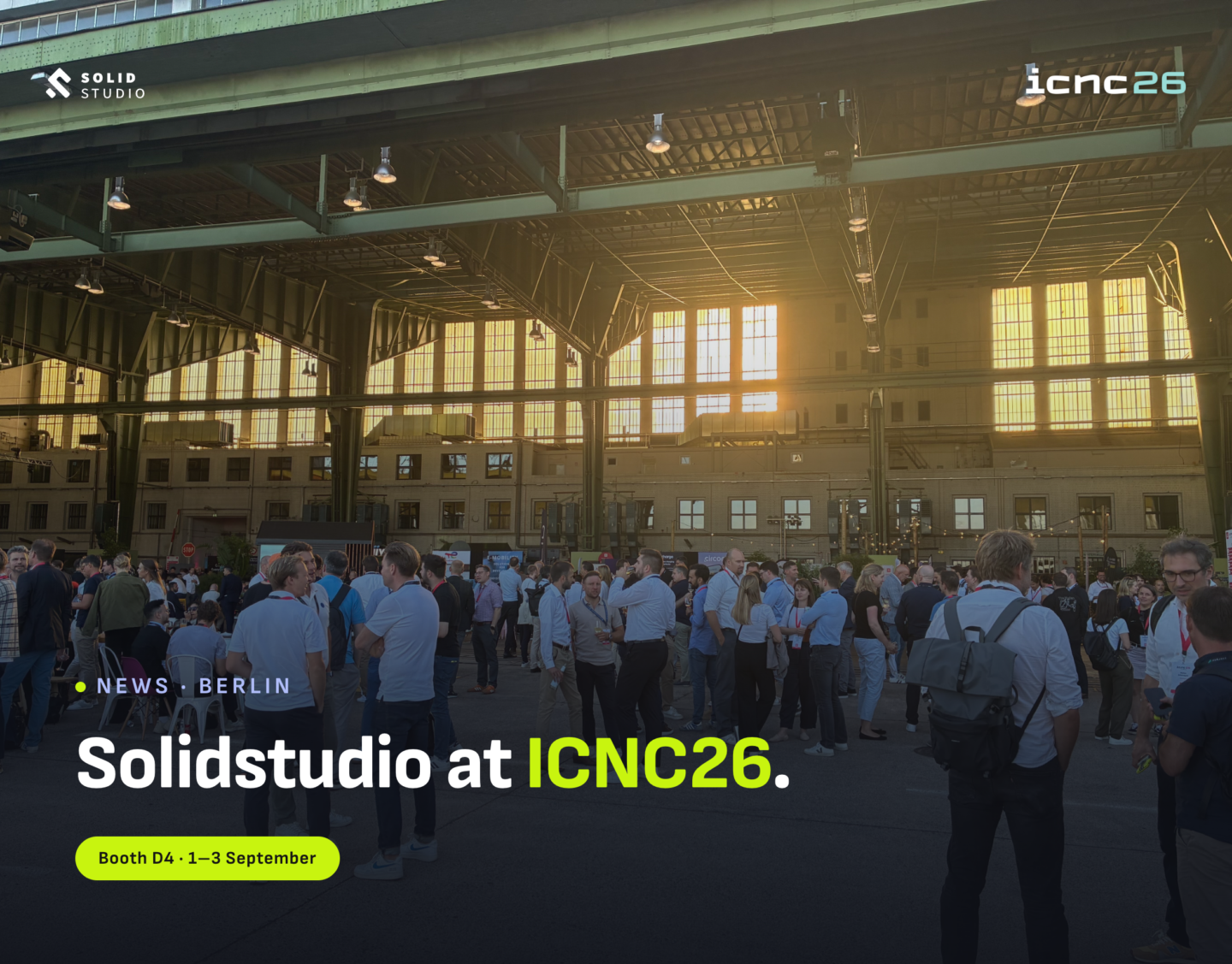
For the first week of September, European e-mobility moves to Berlin. ICNC brings the roaming, interoperability and platform side of the industry into one building, and it does so in the market that is arguably the hardest in Europe to generalise about.
Germany is usually discussed in terms of size. It has the largest public charging estate in Europe, and the numbers get quoted every month. But size is not what makes the German market unusual. Shape is. Germany is the only large European charging market with no centre of gravity, and almost every practical decision a German operator faces – roaming, data reporting, metrology compliance, platform choice – follows from that one fact.
The short version
If you read nothing else:
- Germany has more charge point operators than any other market in Europe, and none of them is big enough to set the standard. The ten largest together run under a third of the country’s charge points.
- Because of that, roaming is not optional for anyone. No operator’s own network covers enough of its own drivers’ journeys.
- And three separate compliance duties land on every operator individually, no matter how small: registering with the energy regulator, reporting live data to a government data platform, and Germany’s measurement law, which treats a charge point the way it treats a petrol pump.
- The third one is the expensive one. Its costs rise with the number of charge points and maintenance events rather than with the size of the company, which means small operators pay proportionally the most.
The rest of this article works through each of those.
The numbers behind the fragmentation
Three figures, from three different places, tell the story together.
The Bundesnetzagentur, Germany’s federal regulator for energy and telecoms, listed 12,819 registered operators of charge points as of 1 May 2026. This is close to a complete count rather than a sample, because German law requires anyone operating a publicly accessible charge point to register it. The rule is the Ladesäulenverordnung, the charging station ordinance, and registering is how a new operator becomes visible to the state at all.
Of those 12,819, an independent tracker working from the same register counted 2,215 that are actually operating, running 181,438 charge points across 47,576 sites in early August 2026. The difference between the two numbers is mostly dormant registrations, one-off single-point notifications, and companies that registered and never grew.
And the figure that matters most: the ten largest operators hold only 29.4% of those charge points.
For context on the national totals, the Bundesnetzagentur recorded 209,605 registered public charge points on 1 July 2026 – 155,264 slower AC points and 54,341 fast DC points, adding up to around 9.04 GW of capacity. That total is higher than the tracker’s because it counts points still going through the registration process.
Put the concentration figure next to almost any other European market and Germany stands out. Elsewhere, two to five operators typically run most of the public network, so a newcomer can work out what good looks like by watching them. In Germany, roughly seven of every ten charge points sit outside the ten biggest networks. There is no market leader to copy.
Why the market is shaped this way
Fragmentation in Germany is not an accident of a young market. It is produced by four structures that are all still active.
Municipal utilities operate at municipal scale. Germany has hundreds of Stadtwerke – town and city-owned utility companies – and between them they run a large share of the public charge points in German towns. Each one is a separate company with its own tariffs, its own procurement and its own board. A national charging network assembled out of city-sized networks is fragmented by construction.
Federal tendering creates new operators rather than concentrating existing ones. The Deutschlandnetz programme allocated roughly 1,000 sites and around 9,000 high-power points across eleven private companies, and for at least one of them winning a lot was its entry into the CPO business. The heavy-duty extension awarded on 1 July 2026 did the same again: 124 unstaffed rest areas and 836 charge points, of which 447 are megawatt-class, split across five lots. Each award mints or expands an operator rather than consolidating the field.
County and municipal kerbside concessions split deliberately. The pattern in German county tenders is to divide a programme across several operators rather than award it whole. One 2026 county programme allocated 202 sites and more than 620 charge points across three separate operators. That is a design choice about resilience and competition, and it produces multi-operator local markets.
Public money is currently flowing toward depots, which are structurally small. The federal heavy-duty charging programme announced in spring 2026 commits €1bn over four years, with €200m in the first calls and support of up to €500 per installed kW, covering both publicly accessible infrastructure and operators’ own depots. Depot charging produces operators with a handful of sites and very high power per site. It adds to the long tail rather than the head.
Consolidation does happen – networks are bought, and some municipal utilities have sold their charging estates and exited entirely. But new operator formation is currently running faster than consolidation, and the federal funding pipeline is pointed at the small end of the market.
Consequence one: roaming is not a growth feature, it is the product
A quick reminder of what roaming means here, because it is the same idea as mobile phone roaming. It is the arrangement that lets a driver holding one operator’s card or app charge at a different operator’s charge point, with the money finding its way back to the right party afterwards.
In a concentrated market, an operator’s own network covers enough of its customers’ journeys that roaming is a nice extra. In a market where the ten largest networks together cover under a third of charge points, no operator’s own footprint is enough for its own drivers. Every operator’s coverage is mostly somebody else’s charge points.
This is why the German setup is harder than most. There are two ways operators connect to each other: through a hub, which acts as a central switchboard between many operators at once, or bilaterally, meaning a direct connection between two companies. Germany uses all of it.
There is a large international hub, historically running its own protocol and now adding support for the main open standard. There is a second hub built for and by the municipal utilities, which speaks a different set of standards again and connects several hundred German operators. And direct bilateral connections run alongside both, because the main open standard is designed to work either through a hub or straight between two parties.
The protocol names – OICP, OCHP, OCPI – are simply the different languages used to exchange this data. What matters commercially is that they are not interchangeable, and Germany is the market where an operator is most likely to need more than one.
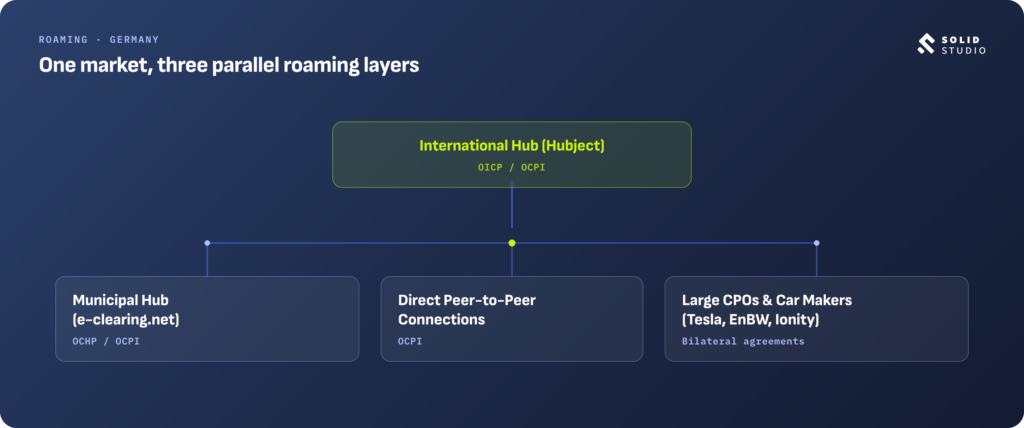
So “we support OCPI” is not an answer to the German question. A platform serving a German operator needs to speak the international hub’s protocol, the municipal hub’s protocols, and direct bilateral connections, because a German operator with any ambition will end up needing more than one route.
Consequence two: three compliance regimes, none of which scales down
Here is where fragmentation stops being an interesting observation about market structure and starts costing people money.
A German operator running publicly accessible charge points has three separate duties, to three different sets of authorities. They are easy to confuse with each other, and meeting one does not help with the others.
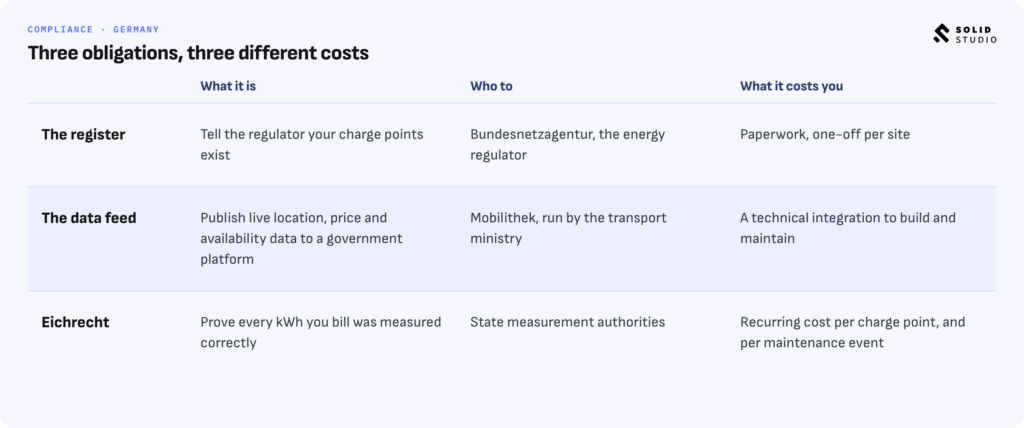
None of the three gets proportionally cheaper for a small network. That is the whole problem.
One: the register
Every operator of publicly accessible charge points has to notify the Bundesnetzagentur under the charging station ordinance. This is the duty most operators know about, and it is what produces the 12,819-operator figure above. It is also the mildest of the three: a registration procedure, not a system you have to keep running.
Two: the data feed to the national access point
Every EU country has to run a “national access point”, which is simply a government platform where mobility data is published so that anyone – map apps, route planners, journalists, other operators – can use it. Germany’s is called the Mobilithek and it is run by the federal transport ministry.
Since 14 April 2025, under Article 20 of the EU’s Alternative Fuels Infrastructure Regulation (AFIR, the regulation that sets common rules for charging across the EU), operators of publicly accessible charge points have had to supply data about their infrastructure to that platform, free of charge and on equal terms to everyone.
The data splits in two. Static data is the stuff that rarely changes: where the charge point is, what connectors it has, how you pay. Dynamic data is the live stuff: whether the point is free right now, and what the ad-hoc price is, meaning the price a driver pays without any contract or subscription. Live values are expected to be accurate within a minute. Charge points that give electricity away free are exempt from the live data requirement, but still have to publish the static data.
Since 14 April 2026, that data has to arrive in a specific format called DATEX II. DATEX II is not a German invention – it is the European standard for exchanging road and traffic data, and an EU implementing regulation now makes it mandatory for this purpose across the Union. Germany publishes its own agreed version of it for charging infrastructure, with separate templates for static and live data.
Two things about this are worth saying plainly.
It is a separate duty, and it is not the one operators already know. Registering charge points with the Bundesnetzagentur and publishing data to the Mobilithek are different obligations, to different ministries, with different content in different formats. Being in the register does not mean your reporting is handled. There are proposals to route commissioning and decommissioning notices through the Mobilithek automatically in future, which would cut the duplication, but that is a plan rather than the current position.
The gap in compliance is large, and it sits in the long tail. Around April 2026, roughly half of Germany’s publicly accessible charging infrastructure was available through the Mobilithek, measured by charging power. Not half of operators – half of the power. The ten largest operators hold under 30% of charge points and are the ones most likely to have engineers available to build a data feed, so the missing half is overwhelmingly the small and mid-sized operators. Thousands of companies, each individually responsible for a technical integration nobody budgeted for, with no market leader’s implementation to copy.
And there is a commercial sting beyond compliance. The charging data aggregators and the apps drivers actually use increasingly take their German data from the Mobilithek. An operator missing from it is not just non-compliant. It is quietly disappearing from the tools its own customers use to decide where to charge.
Three: Eichrecht, the one that actually hurts
The third duty is the purely German one, and it is why Germany has a reputation among operators as the hardest country in Europe to run a charge point in legally.
In plain terms: in Germany, a charge point that sells electricity is legally a measuring instrument, in exactly the same category as a petrol pump or the scales in a butcher’s shop. It has to be officially verified before use, verified again at intervals, and every kilowatt hour you bill has to be provable to the customer afterwards. The law is the Mess- und Eichgesetz, the measurement and verification act. The national metrology institute sets the technical requirements and each German state has its own authority that enforces them. The transition period for charging stations ended on 1 April 2019, so this has been fully in force for years.
Fitting a certified meter is not enough on its own. The rule covers the whole chain from the meter to the invoice: readings have to be recorded, digitally signed and stored so they cannot be altered afterwards. And on request, the operator has to hand the customer the signed data so they can check the bill themselves using approved verification software. In practice, every session you bill needs a signed, stored, retrievable record sitting behind it.
Two features of this collide badly with a fragmented market.
The cost follows charge points and incidents, not company size. Charge points normally need re-verifying every eight years. But re-verification is also triggered by ordinary operational events – replacing a cable, certain maintenance, and cable theft.
In April 2026, eight industry bodies – ZVEI, ADAC, BDEW, BVES, CharIN, e-Mobility Deutschland, INSPIRE and S.A.F.E. – wrote jointly to the federal economics ministry to say the official assumptions here are wrong. The authorities work on roughly 6,000 verifications a year, based on the eight-year cycle. The associations put the real figure at more than 45,000 a year once operational triggers are counted, with as many as 100 triggering events on some days. They say verifying a single DC charge point regularly costs over €500 and takes at least two hours. And a decision taken by the state authorities’ working group in November 2025 would increase the number of measurement points checked from two or three to at least eight, which would push both time and cost up further.
The test equipment requirement lands hardest on the smallest operators. For DC and high-power charge points, state authorities currently expect the operator to provide the test equipment itself. That is not how it works for AC charge points, and it is not how it works for petrol pumps. This equipment routinely costs six figures.
The associations make the fragmentation argument themselves: having every operator buy its own set is economically wasteful and falls disproportionately on smaller operators. They also point out that there is still no nationwide technical specification for the equipment, so nobody knows for certain whether a set bought in one state can be used in another. Some operators have already been asked in writing to provide it, in a few cases with the possibility of shutdown and substantial fines mentioned.
There is a software angle too, and it matters when choosing a platform. Because the measuring chain is legally controlled, a software update that touches it has to have its suitability assessed by the relevant state authority first, which delays re-verification. The associations have asked for an exemption for charging infrastructure, a sampling procedure instead of case-by-case checks, and a sensible transition period.
The practical takeaway is about where you draw a line in your architecture. Anything inside the legally sealed measuring chain inherits this whole verification process, including its delays. Keeping tariffs, session management, roaming and reporting cleanly outside that boundary is what allows normal software delivery to happen at all.
Worth watching: none of this is settled. The associations’ main ask is that Germany adopt the revised EU Measuring Instruments Directive, and specifically its new annex covering charging infrastructure, so that European rules apply and the German special case goes away. Their argument is that German-specific requirements currently mean approval procedures lasting up to twelve months and higher build and running costs than comparable European countries. As of late July 2026 this was still an open request on the record, with no change in the law yet. Anyone building a multi-year German investment case should be watching it, because the compliance cost base could move.
What this means for a platform decision
Put it together and the German question looks different from the same question anywhere else.
An operator with a few hundred charge points cannot work out what good looks like by copying the market leader, because there is no market leader with meaningful share. It needs roaming from day one, across more than one route, because its own network will never be enough for its own drivers. It carries exactly the same data reporting duty as an operator a hundred times larger, with a fraction of the engineering capacity. And it carries a measurement regime whose costs track charge points and maintenance events rather than company size.
That last combination is the one most often underestimated. A reporting obligation that a large operator absorbs as a minor internal project is, for a 200-point regional operator, a real question about whether it needs to hire someone. A verification regime that a large operator staffs a compliance function for is, for that same operator, a recurring cost with a hard floor under it.
We have taken the view that reporting to the national access point should not require a development project. DATEX II reporting to the German national access point is implemented in the Solidstudio platform and in production use.
One practical note worth knowing: operators in North Rhine-Westphalia and Baden-Württemberg can get implementation help connecting to the Mobilithek from their respective state mobility data platforms. Worth using if you are in either state.
Berlin, next week
If you are at ICNC and any of the above is a live question for your network – roaming across multiple paths, getting a compliant DATEX II feed in place, or where the verification boundary should sit in your stack – we are on booth D4 and happy to go through it properly.