

Silent failures: the EV charging problem your monitoring can’t see
Online isn’t the same as working
A charger can be online, connected and reporting normally, and still deliver nothing. No fault code. No alarm. Just a driver standing next to a dead charger.
These are silent failures. They don’t show up in uptime dashboards, and most operators only learn about them when a driver complains. Many drivers never do. They just charge somewhere else next time.
This article explains what silent failures are, why standard monitoring misses them, why charging success rate tells you more than uptime, what they cost, and how operators can catch them before drivers do.
What is a silent failure?
A silent failure is a charging problem that never triggers a fault. The charger looks healthy to your systems, but the driver doesn’t get the energy they came for.
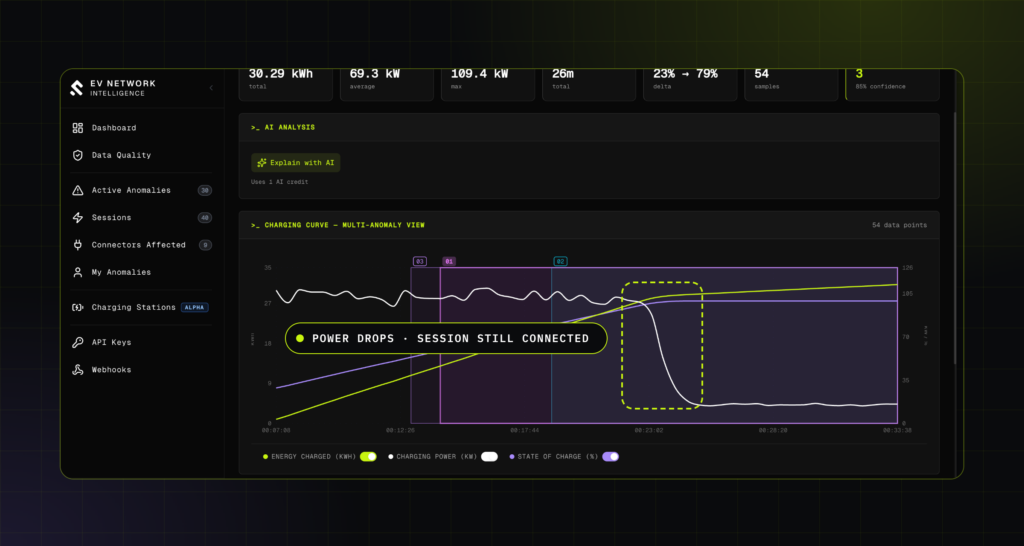
The classic example: a vehicle is plugged in and connected for hours, and zero energy is delivered. To your monitoring, that’s a normal session. To the driver, it’s a broken charger.
The difference between a fault and a silent failure is simple. A fault announces itself. A silent failure has to be found.
Why uptime metrics miss them
Most monitoring answers one question: is the charger online? It tracks connectivity and the status the charger reports about itself over OCPP. If the charger says it’s available and the connection is up, it counts as up.
That’s the gap. Status tells you a charger is reachable. It doesn’t tell you it’s working. A charger can report “available”, accept a session and still fail to deliver energy, and nothing in a status view will flag it.
So a network can show strong uptime on paper while drivers are having a very different experience. Catching the difference means looking at what actually happened in each session, not just what the charger reported.
That’s why the industry is moving to a better measure: charging success rate, the share of charging attempts that actually deliver energy to the driver. The gap between the two can be large. In an analysis by consultancy P3, one CPO reported 98.3% uptime, yet only 86.2% of its charging sessions were classified as regular (P3 Group).
On paper, that network was up. For roughly one session in seven, it may not have been working.
Common types of silent failure
- Zero-energy sessions. The vehicle is connected and the session runs, but no energy flows. This is the most common and the hardest to spot without session data.
- Under-delivery. Energy flows, but less than it should. The session ends looking normal while energy goes undelivered and unbilled.
- Failed attempts that look like driver error. Repeated failed starts are easy to dismiss as user mistakes. Some are. Others point to a charger that needs attention.
- Recurring issues that get “fixed” and come back. A ticket is closed, the status turns green, and the same problem returns a week later, because the symptom was cleared, not the cause.
- Blind spots. Some chargers report incomplete telemetry. If a charger never reports a problem, no monitoring built on its reports will ever see it.
What silent failures cost
Silent failures hit an operator in three places at once.
- Revenue. Every zero-energy or under-delivered session is energy you didn’t sell. Because nothing flags it, the loss never shows up as a problem to fix.
- Drivers. A driver who hits a dead charger rarely files a ticket. They just don’t come back. That cost compounds long after the failed session.
- Operations. Without a clear signal, teams chase symptoms and false alarms. Time goes into firefighting instead of fixing root causes.
The cost is highest where it’s least visible. A known fault gets fixed. A silent failure keeps costing you until someone finds it.
How big is the problem?
In one operator’s network, over a three-month period, EV Network Intelligence found 950 charging attempts that delivered no energy at all. That’s more than 10 a day, and none of them raised an alarm.
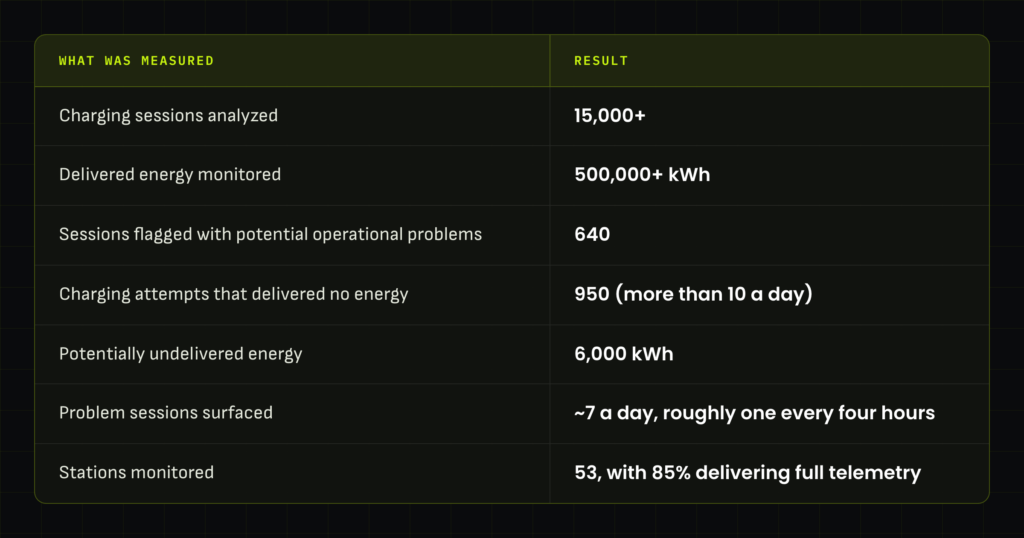
Seven problem sessions a day is already more than most teams can review by hand, and the number grows with every charger you add.
Figures reflect one operator’s network over a three-month period and are illustrative of platform capability, not a guaranteed outcome.
How to catch silent failures
Finding silent failures means changing what you measure. Six practices make the biggest difference.
- Measure energy delivered, not just status. Track kWh per session alongside connectivity. A session that runs for hours with zero energy is the clearest signal you have.
- Separate real faults from noise. Not every failed attempt is a broken charger. Learn the difference, or your team will drown in false alarms.
- Compare each station to its own normal. A station that behaves unlike its own history, or unlike its peers, is worth a look before it fails outright.
- Look for patterns, not single alerts. One failed session is an incident. The same failure recurring across sessions points to a root cause you can fix once.
- Verify fixes with sessions, not tickets. A closed ticket says the work was done. Only correct charging sessions prove the problem is gone.
- Know where you’re blind. Map which chargers report incomplete telemetry, so you know where your view of the network stops.
At a handful of chargers, a sharp team can do some of this by hand. At network scale it has to be automated.
Where Network Intelligence fits
EV Network Intelligence is Solidstudio’s AI layer for charging networks. It analyzes every session to catch silent failures, tell real faults from harmless failed attempts, and point to the likely root cause. It identifies anomaly types with 97% accuracy, so your team works on real problems.
It’s a native module of the Solidstudio CPMS and a standalone product on any other CPMS. There’s no re-platforming and no downtime: start on part of your network, prove the value, then scale.
See what it would find in your network. Book a demo
Frequently asked questions
What is a silent failure in EV charging?
A charging problem that never triggers a fault. The charger appears healthy, but the driver receives little or no energy. The most common form is a session that stays connected for hours with zero energy delivered.
Why doesn’t standard monitoring catch silent failures?
Most monitoring tracks connectivity and the status a charger reports over OCPP. That shows whether a charger is reachable, not whether it’s delivering energy. Silent failures only show up in session-level data.
How can operators detect zero-energy sessions?
By analyzing energy delivered per session, comparing each station to its normal behavior, and flagging sessions that are connected but deliver nothing. At scale, this needs automated, AI-driven analysis.
What is charging success rate?
The share of charging attempts that successfully deliver energy to the vehicle. Unlike uptime, it measures what drivers actually experience, not just whether a charger is online.
What’s the difference between uptime and charging success rate?
Uptime measures whether a charger is reachable and reporting as available. Charging success rate measures whether charging actually worked. A charger can have high uptime and a low success rate, which is exactly where silent failures hide.
Why does a charger show as available but not charge?
A charger reports its own status. It can report “available” while a fault in the hardware, the vehicle connection or the session itself stops energy from flowing. Only session-level data reveals the problem.
Does detecting silent failures require changing CPMS?
No. EV Network Intelligence runs as a native module of the Solidstudio CPMS or standalone alongside any other CPMS, with no migration.